What is the difference between a septic system and a city sewer line for drain problems?
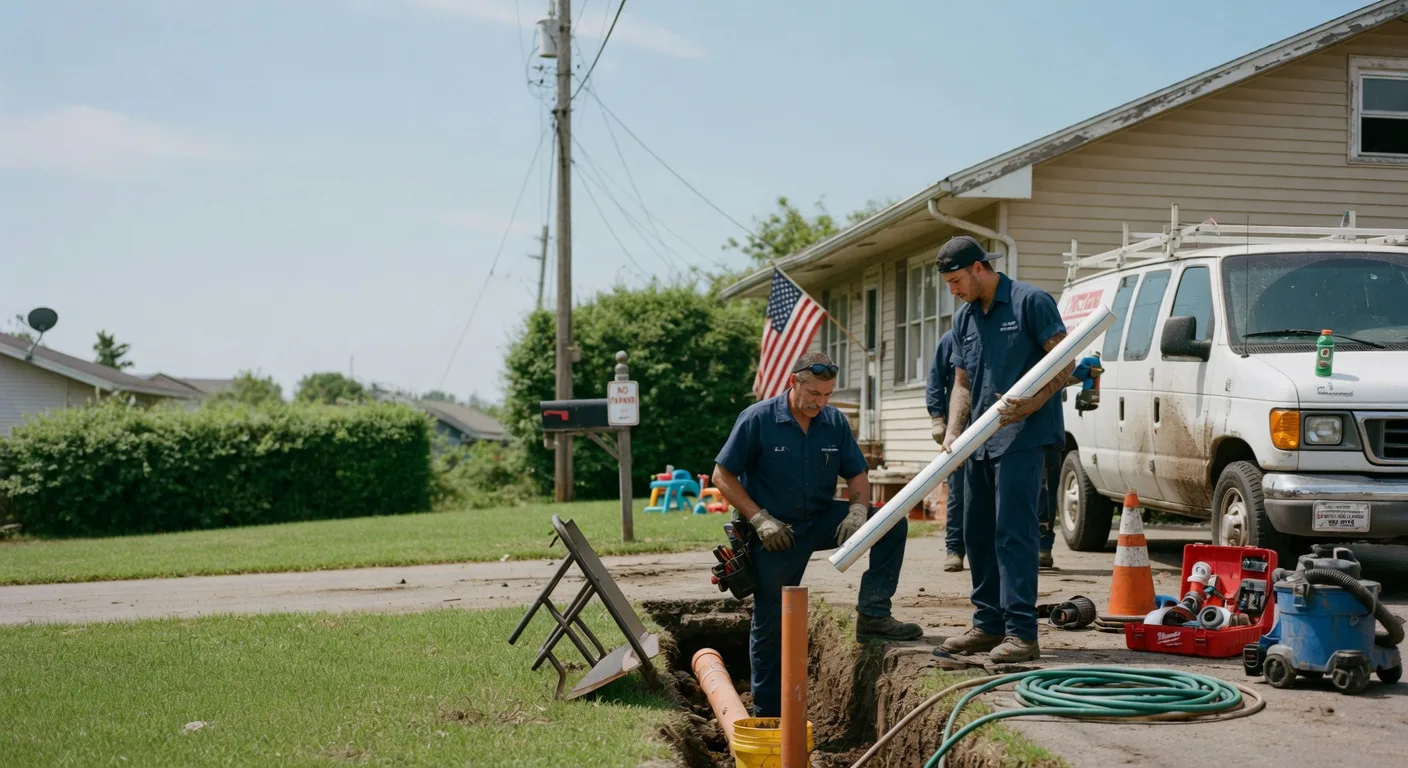
The two systems fail in different places, so the first job is knowing which one your home has. A city sewer line carries wastewater from your house to a municipal main, so trouble is usually confined to the pipe: roots at a clay joint, a bellied section, scale in old cast iron, or a blockage in the lateral. Every drain in the house backing up at once typically means the private line or the connection at the street. A septic system adds a buried tank and a drain field. Solids settle in the tank, and liquid flows out through perforated pipe into the soil. Slow drains or backups can mean a tank that is full and overdue for pumping, a clogged outlet filter or baffle, a failing drain field that can no longer absorb water, or a blockage in the short line between the house and the tank. Soggy ground or a strong odor over the tank area points away from the house plumbing. A cable machine or hydro jetting can clear the house line on either system, but jetting into a septic line needs care about where the water and debris end up. Property paperwork, a cleanout location, or the water utility can tell you which system you have. Expert Plumbers Co connects homeowners with an independent local plumber who works on that type of system.
Homeowners often assume a septic problem and a city sewer problem look the same from the bathroom, but there are a few quick clues. On city sewer, a backup after heavy use is usually the private line or the lateral at the street, and neighbors on the same main may have had the same trouble. On septic, the problem tends to build slowly: drains slow down across the house, the toilet flushes weakly, and a patch of lawn stays wet or unusually green. A common mistake is pouring additives into a septic tank hoping to fix a failing drain field. They do not repair soil that has stopped absorbing water. When you call, tell the plumber how old the system is, when the tank was last opened, and where the cleanout or lid sits. In older homes the tank may be buried deeper than expected and need to be located first, which adds time before any repair starts.
Why does my basement floor drain back up when it rains?
A floor drain that backs up when it rains is usually not a clog in the drain itself. It means the sewer line outside the house is full, and the water has nowhere to go but up through the lowest opening, which is your basement floor.
Heavy rain can push extra water into the main line through cracked joints, root intrusion at a clay joint or a failed sewer lateral. The line fills, and the floor drain shows it first.
Safe homeowner check: on a dry day, pour a bucket of water into the floor drain and see if it runs away normally. Keep stored items off the floor, and do not run the washer, showers or dishwasher during the storm.
Stop running water and call now if sewage is rising, the smell is strong, or every drain in the house is gurgling or backing up. That points to the main line, not one fixture.
A cable machine can clear roots or grease when a blockage is the cause. If the line keeps filling in wet weather, a camera inspection is the next step, because it shows whether the pipe is cracked, bellied or breached. Hydro jetting washes the pipe wall once the cause is known. Cost depends on access, how much has to be opened up, the materials involved and any permit requirement.
Expert Plumbers Co is a referral service. Call (380) 262-9173 and we will connect you with a plumber serving Canton, MN for Emergency Drain Cleaning or a camera inspection.
Pay attention to how fast the drain responds, because it tells you how serious the cause is. If the water rises within minutes of a downpour starting and drops soon after it ends, the line is being overloaded by water entering through cracks or joints. If it stays up for hours after the rain stops, something is also holding water in the pipe, such as a belly or a root mass. Older homes often have clay or cast iron lines with many joints and sometimes a downspout or foundation drain connected to the sewer, which makes wet-weather backups more likely. Newer homes with plastic pipe usually have fewer joints, so a backup there points more strongly to a blockage or a municipal main running full. Tell the plumber when the backups began, how heavy the rain was, and whether any gutters or sump discharge are tied into the house drains. Once the cause is fixed, the floor drain should stay quiet through storms.
My dishwasher leaves standing water at the bottom and the kitchen sink is slow too. Are they connected?
Yes, most of the time. The dishwasher drains into the same pipe as the kitchen sink, usually through the disposal or a connection on the tailpiece. If that shared pipe is partly blocked, both will slow down, and the dishwasher shows it first because it cannot push water out against the restriction.
Grease, food residue and soap film coat the inside of the kitchen drain and narrow it over time. A garbage disposal can pack ground food into that narrow spot. The result is water that sits in the bottom of the dishwasher after a cycle and a sink that empties slowly.
Safe checks you can do: look at the dishwasher filter at the bottom and clear any food. Check that the drain hose is not kinked behind the machine. If you have a disposal, make sure the knockout plug was removed when the dishwasher was installed. Run the disposal with cold water and see whether the sink drains better. Take off the trap under the sink with a bucket below, and clear what is in it. Skip chemical cleaners, which can damage the dishwasher hose and the disposal.
If the filter and trap are clean and both problems remain, the blockage is further down the kitchen line. A cable machine often clears a soft plug of grease and food. If it returns in a few weeks, grease on the pipe wall is the likely cause, and hydro jetting cleans the wall where a cable only cuts a hole through it. A camera inspection can show a sag, a damaged joint or roots further along.
Stop running the dishwasher and call if dirty water comes up in the sink during a cycle, if other drains in the house are also slow, or if you smell sewage.
If the sink drains fine once the dishwasher is off and the problem is only the machine, the cause may be in the appliance, such as the pump or drain hose, and that is a job for an appliance technician rather than a plumber.
Cost depends on access under the sink, how far the blockage sits, whether a cleanout is available, and how much has to be opened or replaced.
Expert Plumbers Co can connect you with an independent local plumber in Canton, MN when you call (380) 262-9173.
Our older house has a house trap, or running trap, in the basement. Why does it keep clogging?
Your basement drain backs up every so often, and each time someone points at the house trap and clears it again. In an older house that is a familiar story.
A house trap, also called a running trap, is a U-bend on the main drain near the foundation wall, with two cleanout plugs. It holds water to keep sewer air out. The trouble is that the dip slows the flow and gives solids a place to settle. Paper, grease, wipes and roots that pass through a straight pipe pile up in the bottom of the bend, so the trap becomes a frequent stoppage point.
Old lines make it worse. Scale in cast iron roughens the pipe and catches debris before it reaches the trap. Root intrusion at a clay joint outside sends fibres toward it. A bellied line downstream can hold water back so the trap never fully clears. Many traps were removed over the years, and local code on keeping or removing one varies.
One slow fixture is usually its own branch problem. If toilets, tubs, sinks and the washer all slow down together, or the floor drain bubbles, the trap or the main beyond it is the likely spot.
Safe homeowner check: Stop using water and look at the two trap plugs without opening them. Check whether the floor drain is holding water, and note which fixtures back up first.
Stop running water and call now if sewage is coming up from a floor drain or shower, if you smell sewage in the basement, or if a plug is weeping. Never loosen a trap plug under pressure, because sewage can surge out.
A cable machine is often enough to clear the trap itself when the stoppage is soft. Hydro jetting is the better choice when grease or scale lines the pipe on either side. A camera inspection is the right step when the trap keeps clogging, because it shows whether the real fault is a belly, a root-filled joint or a failing section further down.
Expert Plumbers Co is a referral service. We connect you with an independent local plumber in Canton, MN. Call (380) 262-9173.
Ask whether the trap can stay and be cleaned when needed, or be removed where code allows. The scope depends on basement access, the condition of the pipe on both sides, how much floor has to be opened up, and any permit or code requirement for changing the main.
Our cabin or second home sat empty for months and now the drains smell and run slowly. Why?
You open the cabin for the first time in months and the drains smell like a sewer and the water creeps away.
Every fixture has a trap, the curved section that holds a little water to block sewer gas. With no use, that water evaporates. Once the seal is gone, gas comes straight up the drain. The film left in the pipe also changes while the house sits. Soap, grease and food residue dry and harden on the pipe wall, so the first heavy use narrows the line and water slows down. Then there is the line itself. A vacant house can still have roots working into a clay or cast iron joint, and nobody was flushing them back with daily flow.
If one sink or tub is slow and the others are fine, the problem is probably local to that fixture, its trap or its branch line. If every drain is slow, several fixtures gurgle, or the toilet bubbles when you run the washer, the blockage is further down, in the main line or the lateral to the street.
Safe homeowner check: run water in every fixture for a couple of minutes, including rarely used ones, to refill the traps. Pour a cup of water into floor drains. If the smell fades and the flow picks up after a day or two of normal use, dried traps and loosened residue were likely the whole story.
Stop running water and call now if wastewater comes up in a tub, shower or floor drain, if the toilet will not clear, if the smell stays strong after the traps are filled, or if you see wet floors, stained ceilings or sagging drywall.
A cable machine is enough when the clog is residue or a soft plug in one branch. If the line stays slow after cabling, if roots are suspected, or if grease has coated the full pipe wall, the plumber will usually recommend hydro jetting, which scours the pipe wall with high pressure water. A camera inspection settles the question of roots, a belly holding water, or a failed lateral.
Expert Plumbers Co is a referral service. We connect you with an independent local plumber in Canton, MN. Call (380) 262-9173.
Before you book, tell the plumber how long the house sat empty, whether it was winterized, and which drains are affected. Ask whether they plan to cable, jet or run a camera first, and what they will do if the camera shows roots or a damaged section. The scope depends on access to the line, the parts or pipe needed, how much has to be opened up, and whether a permit or code step applies to a repair.